Vidyamandir

Learning Approach

Wisdom as a living inquiry.

We collectively explore the eternal and living wisdom from scriptures like the Upanishads, Bhagavad Gita, Dhammapada, and Savitri — in a way that translates wisdom into meaningful daily action.

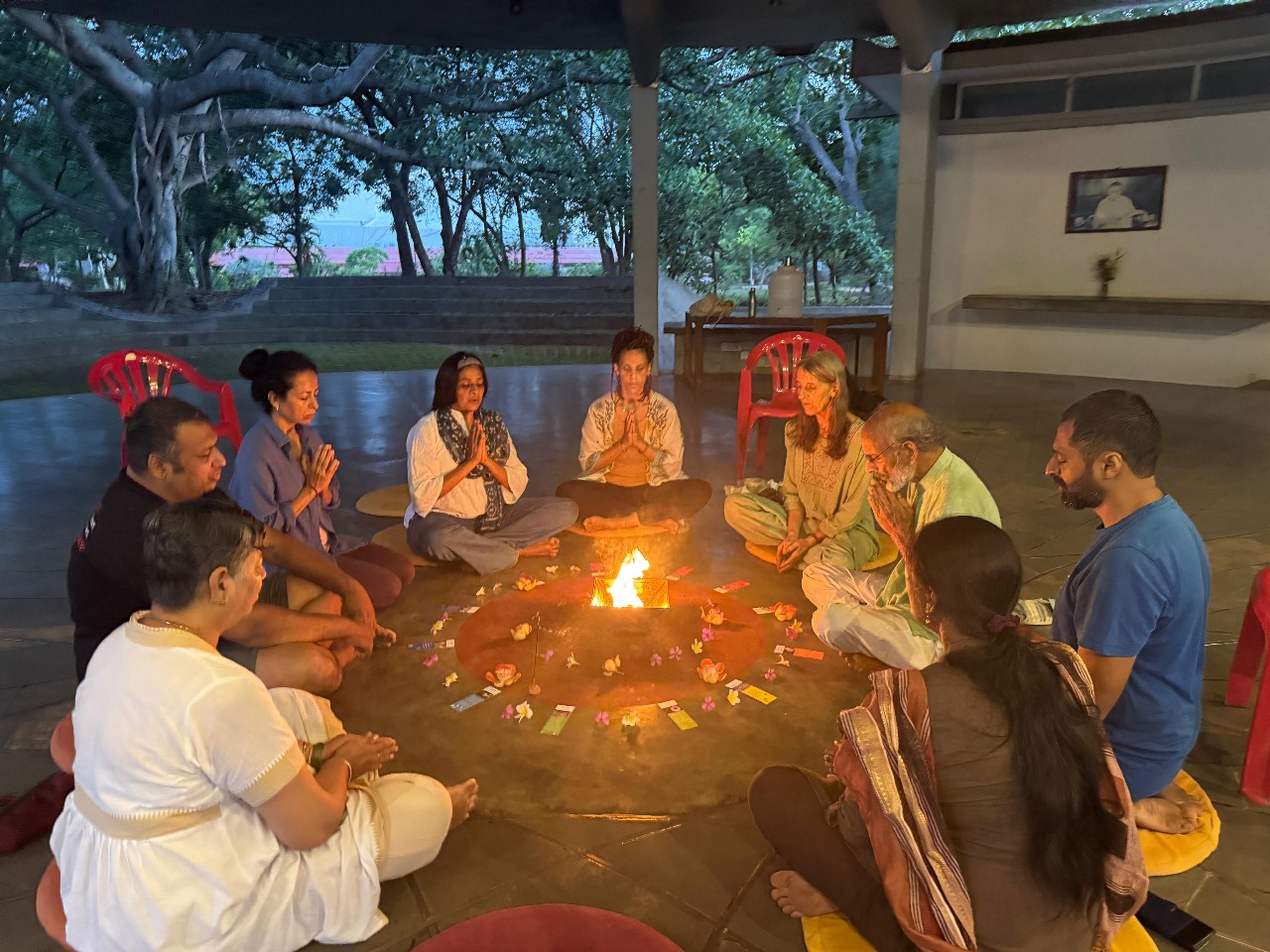
Agni Hotra fire ceremony at Vidyamandir Auroville
“The supreme Shastra of the integral Yoga is the eternal Veda secret in the heart of every thinking and living being. The lotus of the eternal knowledge and the eternal perfection is a bud closed and folded up within us. It opens swiftly or gradually, petal by petal, through successive realisations, once the mind of man begins to turn towards the Eternal, once his heart, no longer compressed and confined by attachment to finite appearances, becomes enamoured, in whatever degree, of the Infinite.”
— Sri Aurobindo

Our Framework

Four movements of learning.

The following learning framework has been deeply enriching for us.

01

Listen

Encounter timeless wisdom with openness and curiosity — receiving the teaching before judging it.

02

Reflect

Explore its relevance through inquiry, dialogue, and self-observation.

03

Embody

Experiment with practices that bring learning into daily life.

04

Realise

Discover insights that emerge through lived experiences.

श्रद्धावाँल्लभते ज्ञानं तत्परः संयतेन्द्रियः ।
ज्ञानं लब्ध्वा परां शान्तिमचिरेणाधिगच्छति ॥

“Who has faith, who conquered and controlled the mind and senses, who has fixed his whole conscious being on the supreme Reality, he attains knowledge; and having attained knowledge he goes swiftly to the supreme Peace.”

— Bhagavad Gita, 4.39

Participant Reflections

The joy and peace we witness keeps us going.

A few messages we have received after participants completed our learning programs.

I have noticed a calmness inside since I started this program — a faith emerging that I am not doing, but it is being done.
It has brought more awareness of the Oneness — of how important it is to not judge, and to love without expectation.
Self-realization is a continuous journey. Such gatherings and sharings are a great help.
Overall, I feel a growing presence of Sri Krishna and the spirit of karma yoga in my daily life through this collective journey.
I want to be available for the Divine to work through me — only now this understanding is more experiential.
After the sessions, I am more aware of my thoughts and actions in my daily life.

Shared with gratitude and, out of respect for their preferences, without names.

Para & Apara Vidya

Higher and lower knowledge.

The most common translation of the Sanskrit word विद्या (vidya) is knowledge. To explore a deeper meaning, we turn to two verses from the Mundaka Upanishad:

कस्मिन् नु भगवो विज्ञाते सर्वमिदं विज्ञातं भवतीति

“What is that, knowing which, everything becomes known?”

द्वे विद्ये वेदितव्ये — परा चैवापरा च

“Twofold is the knowledge that must be known, of which the knowers of Brahman tell — the higher and the lower.”

Science, art, philosophy, ethics, psychology — the knowledge of man and his past, and action itself — are means by which we arrive at the knowledge of the becomings of the world, of its multiplicity and appearances. That knowledge is the lower knowledge, apara vidya.

But as we go deeper, a completer view and experience develop, and each line of growth brings us face to face with the knowledge of the ultimate Reality. The more we overcome our bondage to appearances and multiplicity, the more we transcend into the knowledge of the imperishable and ineffable — the realm of para vidya. The more we grow inward, the more we discover the inner self and inner unity through inner vision and the intuitive concreteness of experience.

— Kireet Joshi, Philosophy of Sri Aurobindo and Indian Pedagogy

The key intention behind all our offerings is to keep the flame of aspiration alive for the para-vidya, even as we learn and engage with the apara-vidya.

“Auroville will be a site of material and spiritual researches for a living embodiment of an actual human unity.”
— The Mother, Auroville Charter

Reflections & Feedback

Our work evolves through what participants share.

Detailed feedback from a participant of the Bhagavad Gita in Daily Life program.

Are there any key learnings, insights, or experiences from this collective journey that you would like to share?

The central learning for me has been the importance of living more consciously — to pause, reflect on my actions, and understand the source of those actions, where the thought is arising from. Alongside this, the practice of separating the self from action, and gradually reducing attachment to outcomes, has stayed with me.

I am beginning to see more clearly that who we are is reflected in everything we do. There has to be a deeper alignment between the work we engage in and the person we are trying to become. I was also deeply moved by a facilitator’s ability to conduct a session immediately after a significant personal loss — a powerful demonstration of living one’s values, not just speaking about them.

Another insight that stayed with me was that the Mahabharata is not just an external narrative but an internal one — its characters representing different forces and voices within us.

Has this collective engagement with the Bhagavad Gita brought about any positive changes in your life?

Yes, though it is still early to speak of tangible changes with certainty. What I do feel is a clear shift in awareness. The 5 am to 6 am Brahmamuhurta time has played a meaningful role — starting the day in that space creates a certain clarity and steadiness, and acts as a gentle reminder to carry that awareness into the rest of the day.

Do you have suggestions to make such collective learning more enriching?

It was a very thoughtfully curated experience. The 5–6 am timing set the tone for the day; meeting every day, including Sundays, built strong momentum; the pause to self-reflect on the verses made the learning deeply personal; the diversity of participants added significant depth; and the approach of holding space rather than instructing allowed for genuine reflection and internalization.

— K*, participant

Shaped by feedback

On days when we are not offering a learning program from 5–6 am, we now hold a space to connect in silence — reflecting in words afterwards only if there is a need. This spontaneous email helped us realise the value of this simple offering:

“Waking up at 4:30 am and spending that time reading, reflecting, sharing, or simply sitting in silence has been profoundly transformative for me. This has become a golden hour in my day.

Please never stop this. Sitting in silence together is as powerful as reading, reflecting, and sharing together. There is something deeply nourishing in simply showing up and being present in each other’s company during these sacred hours.”

— Y*, participant

To respect their preferences, we do not share the names of those who wrote these messages. The full messages are held in our records as received through email and feedback forms.

Come, learn with us.

Explore Our Offerings